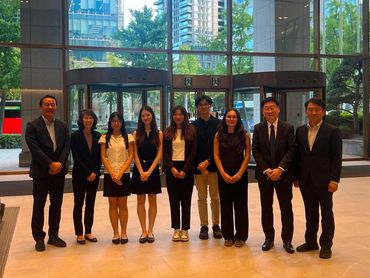
The winning team and the organizers of the KEY Inaugural Debate at Yonsei University in Seoul
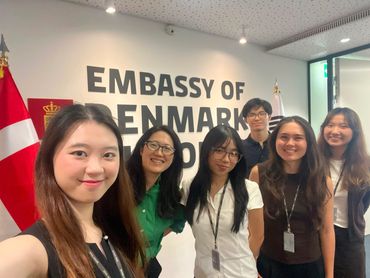
Session at Innovation Centre, Embassy of Denmark in Korea
by Emily Jessica Chappel
Our session with Gowun Kim at Innovation Centre Denmark in Seoul provided valuable insights into how culture influences innovation, entrepreneurship, and business practices. Rather than focusing only on technology itself, the discussion highlighted how societal values shape the environments in which companies operate and grow.
One of the most memorable topics was the contrast between Korea’s collectivist culture and Denmark’s more individualistic approach. Korean workplaces often emphasize hierarchy, group harmony, and respect for established structures, while Danish companies generally encourage flatter organizations where employees are expected to contribute ideas regardless of seniority. This difference extends into everyday business interactions. For example, we learned that exchanging business cards remains an important sign of professionalism and respect in Korea, whereas Danish professionals rarely use business cards, reflecting a more informal business culture.
The conversation also explored how geography and market size influence entrepreneurship. With a population of only around six million people, Denmark cannot rely solely on its domestic market. As a result, many Danish startups adopt English from the beginning to reach international customers and investors. Korean startups, by contrast, often prioritize the domestic market first because of Korea’s larger population and strong local consumer base. This demonstrated that startup strategies are shaped not only by innovation but also by the economic realities of each country.
Finally, we discussed the opportunities and challenges created by emerging technologies. While both Denmark and Korea actively invest in innovation, their approaches differ because of their unique cultural and economic contexts. Denmark tends to foster innovation through open collaboration, flat organizational structures, and globally-minded startups, whereas Korea often emphasizes coordinated efforts within established hierarchies and a focus on domestic industries before expanding internationally. The meeting reinforced that technological advancement is not only about creating new products but also about creating environments that encourage creativity, collaboration, and global competitiveness.
Overall, this session broadened my understanding of how cultural values, market conditions, and business practices influence innovation. It reminded me that successful international collaboration requires adapting to different ways of working rather than assuming that one model fits every context.

Meeting at Kim & Chang: KEY Leadership & Korean Diplomats
by Audrey Chow
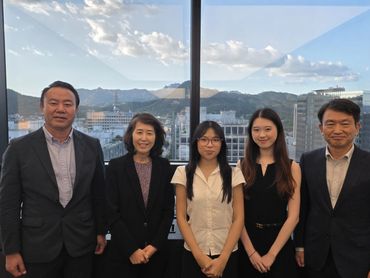
One of the highlights of the Seoul trip was undoubtedly our session at Korea's premier law firm Kim & Chang with the leadership of KEY and two distinguished Korean diplomats. We had the privilege of meeting Mr Philippe Li, Chairman of KEY; Mr JaeHoon Yoo, President of KEY; Ambassador Daejong Yoo, Special Advisor for International Cooperation to the Governor of Gyeonggi Province and former Ambassador of the Republic of Korea to France; and Mme Bin Seo, former Director-General for Public Diplomacy at the Korean Ministry of Foreign Affairs. Walking into the room, I had expected the discussion to heavily focus on international relations, or public diplomacy. Instead, what surprised me most was how genuinely interested they were in learning about us.
We were invited to reflect on our own aspirations and experiences. I was asked what had motivated me to study law, why I had developed an interest in intellectual property, and whether emerging technologies such as artificial intelligence changed the way I thought about my future career. We also discussed Hong Kong's economic outlook and the opportunities and challenges facing young professionals today. It was refreshing to realise that these were not questions with "correct" answers; they were invitations to think more deeply about our own perspectives.
What made the conversation even more memorable was how naturally it moved beyond professional topics. When I mentioned my passion for ballet, we found ourselves discussing Korea's remarkable presence at the Prix de Lausanne and celebrating Sae-eun Park's achievement as the first Asian Étoile of the Paris Opera Ballet. Somehow, the conversation even made its way to Paris restaurants, where I found myself enthusiastically sharing a few personal recommendations. Those moments reminded me that meaningful international exchange is built not only through policy discussions, but also through shared cultural interests and genuine curiosity about one another.
It was equally exciting to hear Mr Philippe Li speak about the future of KEY and the many opportunities for collaboration between the Hong Kong Chapter and other chapters around the world. The discussion reinforced my belief that KEY is not simply a professional network, but a community that values dialogue, mentorship, and friendship across cultures and generations.
My sincere thanks to everyone at KEY Korea for the incredibly warm welcome to Seoul, and especially to Pauline for organizing such a thoughtful and inspiring programme. I look forward to building on the relationships formed during this visit and to contributing to the continued growth of the KEY Hong Kong Chapter.
Small Seminar and Mingling with Yonsei Students
by Amber Yeung
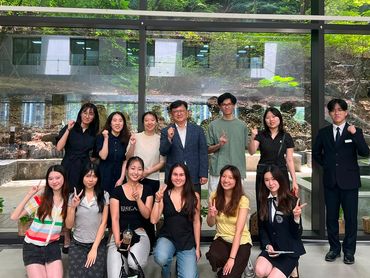
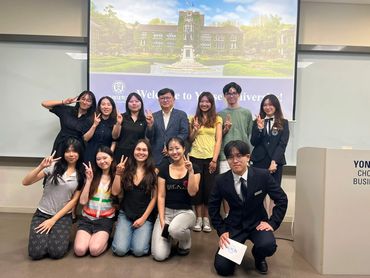
The first scheduled visit on the second day was a small seminar and mingling session with Yonsei students over coffee and snacks, led by Professor Jiman Lee of the Yonsei University Graduate School of Business.
Yonsei’s beautiful campus gave us our first impression of the university, living up to its reputation as one of Asia’s most stunning campuses and a pop culture icon, frequently featured as a filming location for popular K‑dramas. We were warmly welcomed by Professor Lee, his graduate students, and two ambassadors from the business school.
During the mingling session, I had a particularly engaging discussion with one of the student ambassadors about the education systems in South Korea and Hong Kong, focusing on college admissions. In Korea, the highly prestigious SKY universities are regarded as the Korean equivalent of the Ivy League. Admission to these elite institutions represents the pinnacle of academic achievement. By contrast, in Hong Kong, prestige is often associated more with gaining entry into competitive programmes such as medicine, rather than with the universities themselves.
The student ambassadors then led a tour of the New Building of Yonsei Business School. The most striking feature was the Atrium, with its soaring ceilings and expansive floor‑to‑ceiling window overlooking a lush garden, which provides a comfortable environment for both study and relaxation. We also visited the Creativity Lounge, lecture rooms, and other student spaces. Many of these areas carried meaningful traditional Korean names and incorporated greenery and open layouts with thoughtful design.
I feel quite envious that Yonsei Business students study in such a practical yet tastefully designed campus every day; if my own university looked half as good, I might even start smiling at Monday 9 am lectures! Finally, we concluded the tour by taking photos in front of the iconic ivy‑covered Underwood Hall and savoured a delicious Sotbap lunch.
Architecture Tour of Dongdaemun Design Plaza
by Hau In Tang
This masterfully planned trip to Seoul perfectly wraps up the themes of the KEY Inaugural Debate surrounding contemporary culture in Korea. I was especially struck by the architecture tour of the Dongdaemun Design Plaza (DDP), which was an absolute highlight of the journey. Stepping into this iconic landmark designed by the late Zaha Hadid felt like entering a futuristic space, challenging my perceptions of urban design.
Instead of the sharp angles and internal columns often seen in the industrial, futuristic style architecture that we city people are unfortunately accustomed to, the building is defined by its sweeping, curvilinear forms. It features a seamless, fluid structure that mimics a natural landscape, inviting visitors to move through it intuitively.
Learning about the massive engineering effort behind it—such as the 45,000 uniquely shaped aluminum panels and the use of advanced Building Information Modeling—gave me a newfound appreciation for the intersection of art and technology. It proved that visionary concepts do not have to be compromised by structural limitations if innovative engineering is applied.
The tour also highlighted how the DDP serves as a vital cultural hub, bridging Seoul’s rich history with its modern, creative future. Exploring its interconnected zones and sprawling park helped me realize how public spaces can be both innovative and deeply integrated into urban life. I was delightfully amused to experience the liveliness of sports activities and market stalls in the plaza, seeing firsthand how community life breathes spirit into concrete and steel.
As a debater, this observation brought our resolution on cultural preservation full circle: just as a well-crafted argument reconciles competing perspectives, the DDP proves that a meticulously engineered framework can seamlessly harmonize modern societal progress with a community's living heritage.
Visit to Leeum, Samsung Museum of Art
by Arthur Ng
The last officially scheduled visit during the KEY Study Tour was to the Leeum Museum of Art, widely considered one of the preeminent private art museums in South Korea. I arrived not really knowing what to expect – whilst not an art connoisseur by any means, I had envisioned the visit to be an eye-opener in the realm of traditional and modern Korean cultural wealth, but what I experienced was a confluence of these expectations from both East and West.
What I found particularly striking was the museum’s choice of exhibits, a selection which spanned artworks from both Korea and the Western world. Two artists whose works especially stood out to me were those of Damien Hirst and Nam June Paik.
The former’s work could be characterized as an exercise in morbidity as it swivels around the theme of death, contributing to the motif of memento mori as the artist innovatively utilized materials such as taxidermized butterflies and medical pills. In my view, these works represented a sense of rebirth, where old, discarded materials could be recycled and repurposed into stunning, thought provoking and introspective displays, much like the story of South Korea throughout the latter half of the 20th century and the Miracle on the Han River.
These solemn vestiges were visually contrasted by the work of Nam June Paik, the most famous of which being a row of large televisions screens displaying a collage of Buddhist iconography, American pop culture, and grainy Korean folk performances, all blending into one another. I remember reading elsewhere that one of Nam’s sayings was to make ‘time visible’ – particularly through his work Uranus (though displayed elsewhere) and thought this saying resonated much.
Whilst hailing from a previous generation, Nam’s celebration of digital and communicative technologies through his set encapsulates Korea’s development throughout the past decades, representing both a poignant exhalation of the past and a beckoning to the present.
Selected Photos